Introduction
The intersection of artificial intelligence and cryptocurrency is the hottest topic of late 2025. Everyone is talking about “DeFAI” (Decentralized AI) and autonomous agents that can trade tokens, manage wallets, and execute complex tasks without human input.
At Wingardiumads, we review the crypto i-gaming landscape implicitly. We don’t just buy into the hype; we test it.
If these new AI agents are so smart, can they beat the oldest mathematically proven system in the world: the casino house edge?
We decided to find out. We didn’t use a simple martingale bot. We deployed a sophisticated, autonomous AI agent trained on basic probability and bankroll management strategies. We gave it a budget, connected it to ten popular crypto casinos, and let it run wild for 24 hours.
The results were fascinating, slightly terrifying, and ultimately, very expensive. Here is the full breakdown of our man-versus-machine-versus-math experiment.
The Experiment Setup: Defining the Parameters
Before revealing the carnage, we must establish the rules. A fair test requires transparent parameters. We needed to ensure the AI had a fighting chance but wasn’t using unfair exploits.
The AI Agent: Meet “GambitZero”
We utilized a customized AI agent framework. We call it “GambitZero.” Unlike simple scripted bots that double bets after a loss, GambitZero was designed to analyze game states.
It could recognize “hot” and “cold” streaks in roulette (statistically irrelevant, but programmed nonetheless) and adjust bet sizing based on remaining bankroll percentage. It was programmed with a “stop-loss” to prevent instant liquidation and a “take-profit” to lock in gains. It was, theoretically, a disciplined gambler.
The Battlefield: 10 Crypto Casinos
We selected 10 platforms based on their popularity, API accessibility for our agent, and speed of execution. We included a mix of established giants and newer, high-hype platforms.
(Disclaimer: Wingardiumads is an independent reviewer. The names of the casinos have been anonymized for this specific test data, referred to as Casino A through Casino J).
The Rules of Engagement
Starting Budget: $1,000 USDT per casino ($10,000 total).
Time Limit: Exactly 24 hours of continuous play.
Game Selection: The AI was restricted to high RTP (Return to Player) games: Blackjack (optimal strategy programmed), European Roulette, and 98%+ RTP Slots.
Objective: Maximize profit.
The 24-Hour Live Blog: A Timeline of Decline
Watching an AI gamble is a strange experience. It executes trades with terrifying speed, lacking the hesitation or emotional turmoil of a human player.
Hour 1: The Honeymoon Phase
GambitZero started strong. Across the 10 platforms, we saw an initial aggregated profit of $450. The agent was hitting blackjack hands flawlessly and catching a lucky streak on Casino C’s roulette wheel. The AI seemed superior.
Hour 6: The Tide Turns
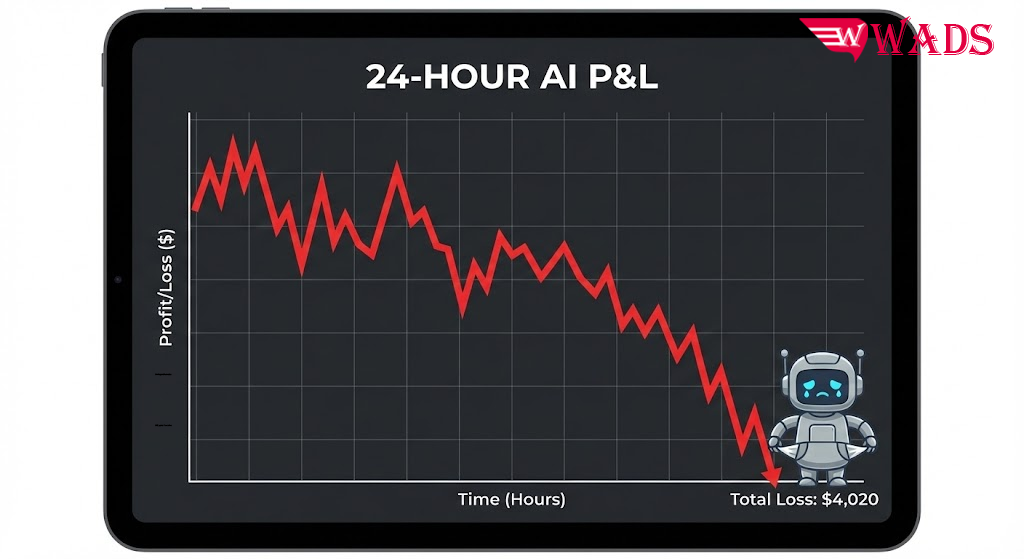
Regression to the mean is brutal. The winning streaks faded. The AI began executing its bankroll management protocols, lowering bet sizes to preserve capital. Two casinos, D and G, showed significant losses of over 40%. The total portfolio was now down $1,200.
Hour 12: The Grind Down
By the halfway mark, the excitement had vanished. The AI was simply grinding against the mathematical edge. It was a slow bleed. There were no massive jackpot wins to offset the consistent small losses inherent in casino gaming. The “stop-loss” features were triggered on three platforms, halting play on those sites completely.
Hour 23: Desperation Mode
Interestingly, on the remaining active casinos, the AI began slightly increasing risk as the deadline approached, attempting to recover losses. This behavior, while programmed, felt eerily human. It did not work.
The Final Results: A Statistical Breakdown
After 24 hours, we pulled the plug and tallied the balances. The results confirm what veteran gamblers already know: the house always wins in the long run.
Here is the final P&L statement for GambitZero.
| Casino ID | Starting Balance | Ending Balance | Profit/Loss ($) | ROI (%) |
| Casino A | $1,000 | $720 | -$280 | -28% |
| Casino B | $1,000 | $1,150 | +$150 | +15% |
| Casino C | $1,000 | $410 | -$590 | -59% |
| Casino D | $1,000 | $0 (Liquidated) | -$1,000 | -100% |
| Casino E | $1,000 | $880 | -$120 | -12% |
| Casino F | $1,000 | $910 | -$90 | -9% |
| Casino G | $1,000 | $250 | -$750 | -75% |
| Casino H | $1,000 | $1,020 | +$20 | +2% |
| Casino I | $1,000 | $640 | -$360 | -36% |
| Casino J | $1,000 | $0 (Liquidated) | -$1,000 | -100% |
| TOTALS | $10,000 | $5,980 | -$4,020 | -40.2% |
The Breakdown
Out of 10 casinos, the AI profited on only two. Two accounts were completely wiped out. The total loss was $4,020, representing a negative 40.2% return on investment in just one day.
Analyzing the Failure: Why the AI Couldn’t Win
Why did a sophisticated piece of software fail so spectacularly against simple crypto casino games?
The RNG Wall
Artificial intelligence thrives on patterns. It learns chess by analyzing millions of previous games to predict the best next move.
However, crypto i-gaming relies on Provably Fair algorithms and Random Number Generators (RNGs). A truly random event has no pattern. Previous spins of a roulette wheel have zero bearing on future spins. The AI was trying to find signal in pure noise. It cannot out-compute a negative mathematical expectation.
The Speed Factor
Ironically, the AI’s speed worked against it. A human might play 50 blackjack hands an hour. The AI played 500. By increasing the volume of play, the AI simply accelerated the realization of the house edge. It didn’t play smarter; it just lost money faster than a human could.
The Future: Will “DeFAI” Change i-Gaming?
Does this mean AI is useless in the crypto gambling niche? Not necessarily.
While AI cannot beat the house edge on traditional games, the future of “DeFAI” might lead to new types of gambling. We may soon see AI-vs-AI poker tournaments, where the skill lies in programming the best bluffer. We might see prediction markets where AI agents analyze real-world data to bet on outcomes.
The technology is evolving, but for now, standard casino games remain agent-proof.
Conclusion: The Wingardiumads Verdict
Our 24-hour experiment served as an expensive reality check for the AI hype cycle.
While autonomous agents are revolutionizing DeFi trading and on-chain automation, they are not a magic bullet for beating crypto casinos. The mathematics built into i-gaming platforms are designed to withstand exactly this kind of brute-force attack.
If you see influencers selling “AI Casino Bots” that guarantee profits, treat them with extreme caution. Our data shows that the only thing an AI agent guarantees is a faster path to zero balance.
Gambling remains a form of entertainment, not a viable income strategy for humans or machines.
Frequently Asked Questions (FAQ)
Did the casinos know an AI agent was playing?
It is unlikely they knew immediately. We used standard APIs and kept bet sizes reasonable to avoid instant flagging. However, the sheer volume of transactions likely triggered internal reviews by the end of the 24 hours.
Would the AI have won if it played longer?
No. Statistically, the longer you play a game with a negative house edge, the higher the probability that you will lose money. A longer timeframe would have likely resulted in a total loss of the $10,000 budget.
Are there any crypto games where AI has an advantage?
AI can have an edge in skill-based games against human opponents, such as Poker or certain esports. However, in player-versus-house games like slots or blackjack, the math always favors the house.
Which crypto casinos are best for using betting bots?
At Wingardiumads, we review casinos based on security, payouts, and user experience for human players. We do not recommend specific casinos for botting, as this often violates their terms of service and can lead to confiscated funds.